
The Importance of Training With Power
By: Luke Lewis
Last updated: August 11th, 2026
I've spent most of my life around a barbell as both a thrower and a coach. For a long time, I measured progress the way most people in the weight room do: by how much weight is on the bar. More plates, more progress. It took me a while to realize that that's not really what matters. For an athlete, it's not just about how much weight you can lift. It's also about how fast you can move it.
1. The Problem With Chasing Weight
I'll be honest about my own history here. I have loaded the bar with too much weight plenty of times in an attempt to get stronger — sometimes with a spotter, sometimes without one. In doing that, I risked injury and I didn't necessarily get stronger. I walked away with a number and not much else.
Now, sometimes 1RMs are necessary. There's a time to test and find out exactly where you stand. But as a day-to-day approach, chasing the max is a losing game because the risk climbs faster than the results do.
What's much better is to be competing with a certain threshold, which is exactly what focusing on power and velocity allows for. You're working with the same goal of wattage no matter what's on the bar. Even if you're working at, say, 75 percent of your max weight, you're going to try to move it at a speed that would be comparable to your power on a heavy two-rep. The load changes but the intent doesn't.
Velocity also allows you to compete with yourself inside a set. For example, let's say you move your first rep of a high rep set at 0.7 m/s. Now, you're trying not to drop below 0.5 m/s for the rest of the set. You're trying to stay in that same range, and every rep has a standard to meet.
It works set to set, too. If you're doing peak velocity on an Olympic lift, say four sets of two: you start your first set moving it at 1.85 m/s. Next set, you're at 1.90. Next set, 1.95. Next set, 2.00. That's a really good way to see progression through the sets while never adding a single pound to the bar.
That's the shift for me. The weight on the bar tells you what you attempted. How fast you moved it tells you what you actually achieved.
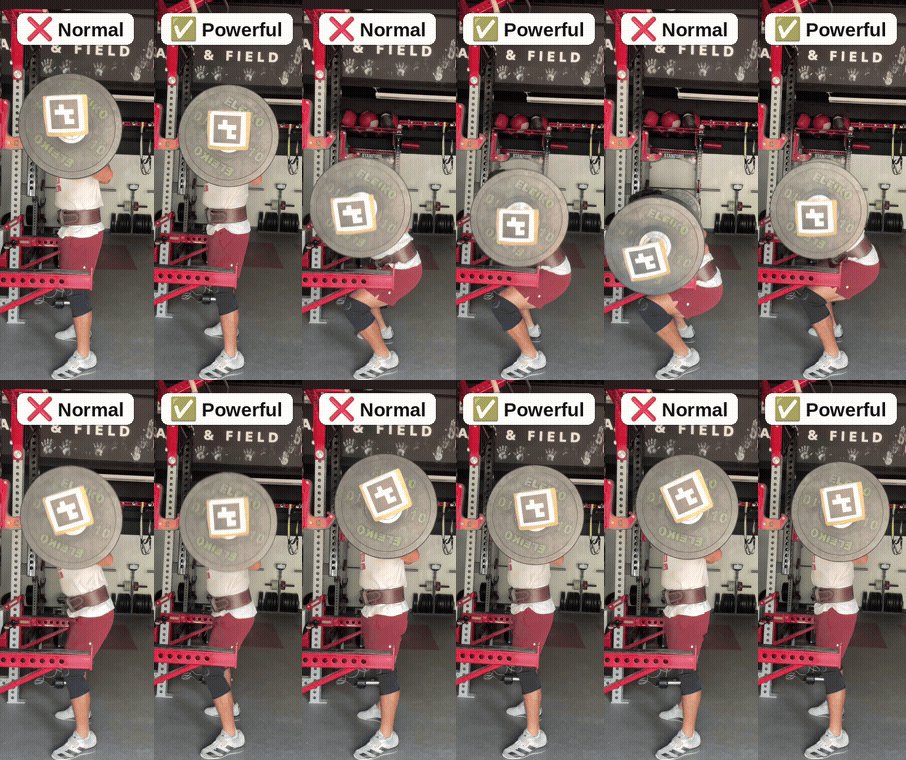
2. Power Is Weight × Speed; Speed Is What Transfers
There are obviously different types of athletes in every sport. Take the shot put for example. A lot of the best shot putters are tall, long, and heavy — people who can put force into the ball with sheer size. I'm not built like that, and I can only control so much regarding my size. What I can control is my explosive power, and that is very much my focus. If I want to be as good as I can possibly be in my event, velocity and power are essential for me.
For coaches, it works the same way. Velocity provides another dimension to measure an athlete's explosiveness, which is huge beyond just sheer max weight. It gives you a much better picture of relative strength. Put the same weight in front of two athletes: if one moves it meaningfully faster, those are two different athletes.
But there's a layer to this that I think most programs miss, and it's what happens within a single rep.
With a fixed load, your body already knows the bar has to stop at the top. So on any truly explosive rep with straight weight, one of two things is happening: either you're releasing it, your feet leave the ground, or you're spending the last part of the range of motion putting on the brakes. This means that, with a constant load, part of every “explosive” rep is essentially training you to decelerate.
Sport asks for the opposite. In most sports, you're trying to accelerate through movement. The athlete must accelerate through a throwing motion, through the stick, through a jump. Nothing stops partway through the range of motion. Nothing in competition rewards hitting the brakes.
That's why, in season, we're specifically looking at overloading movement as much as we can where you're strongest: banded box squats, where it's heaviest at the top. Banded bench press, also heaviest at the top. Med ball throws, where you're trying to accelerate out of the movement. Bench press throws, where you're letting go of the weight entirely. All of these velocity-based movements are essentially trying to recruit fast-twitch with a heavier load, and I think this is the most applicable type of training to the majority of sports. When the resistance varies through the range, you're loaded hardest where you're strongest, and you're forced to keep pushing through the exact part of the lift where straight weight teaches you to coast.
That's the real argument for varying load through the movement: it doesn't just build strength that looks explosive in the weight room. It builds the acceleration that actually shows up in your sport.
3. The Bar Doesn't Lie: What Speed Tells You Today
Bar speed is also a really good indicator of where you're at on a fatigue level.
Say you come in after poor sleep, a week after you did the same exact workout feeling great. Even with the same weights, you're going to see that your speed is decreased (and therefore your power is decreased). That's a way to pick up on where your body is at before you load up a huge amount of weight and get crushed by it. This can help prevent injury before it happens. The plan might say 85 percent, but your warm-up speeds will tell you whether or not today should actually be an 85 percent day, and you can adjust before the heavy loading instead of after a bad rep.
It can also help take the ego lifting out of it. The number doesn't care what you did last week or what the guy next to you is doing, it only reports what you produced today. This isn't to say you should be outsourcing awareness to a device — it's important for an athlete to develop their own intuitive feel for their body. Rather, I've found that power and velocity readings actually help teach that skill. See your power output enough days in a row, and you start calibrating what you feel against real data. The technology doesn't replace body awareness. It builds it.
4. Intent Over Grind: A New Definition of Progress
Everything above points to a new way to train hard. The old way is the grind — pile on weight and fight it. The new way is intent: take a submaximal load and move it with everything you have. Focus on power and velocity no matter how much weight is on the bar. You get the explosive stimulus you're actually after, without grinding out rep after ugly rep to get it.
It gives coaches a brake pedal, too. Set a velocity or power cutoff and end the set once a rep drops below it. This can help athletes stop before form breaks down; before fatigue turns good work into health risk.
But the part I care about most is what this does to the definition of progress. In the old model, there's only one PR that counts: more weight. Velocity opens up a second category: the same weight but faster. In other words, more powerful. Trust me: when you're able to move a weight that was once your PR at the speed you used to move your 75 percent at, it's a pretty great feeling. You know you're a lot more ballistic, a lot more explosive, and a lot more well-rounded as an athlete.
There's a belief piece here too, which I feel personally. As an undersized athlete in my event, being able to demonstrate the capacity to generate power shows the advantage a somewhat undersized athlete can have over a bigger, more physically gifted one. That athlete may be able to move more weight at a slower rate, or simply have levers I'll never have. But power output is somewhere I can show a real, measurable edge. And that makes this another tool for both coaches and athletes to gain belief — in both the people they're coaching and in themselves. Belief backed by data, not a pep talk.
5. Explosiveness is everything in athletics
I see it most clearly in my own world. In track and field, it's central to most events—throws, sprints, jumps, even distance to a degree (though not as much). In other sports, explosiveness—that ability to accelerate—is a major differentiating variable. In many cases, alongside sport-specific skill and technical proficiency, it's what separates athletes.
Here's the part that should change how people train: explosiveness is something that can be developed, like a skill. You can't coach height. You can't coach levers. But the ability to accelerate responds to training, and it keeps responding when you train it deliberately. For any athlete who wasn't handed the biggest body in the gym, that fact matters a lot.
When you're training bar speed, you're not just chasing a gym number. You are training the exact trait that shows up in a first step, a vertical, a throw, a swing: explosive power.
6. You Can't Train What You Don't Measure
Traditional weights don't measure velocity or power for you. Slowly but surely, athletes are looking for solutions to measure their velocity and, therefore, their power output. At the highest levels, it's spreading fast. For high schoolers and lower-level collegiate athletes, it's definitely not as prominent as it could be. I think that's backwards, due to the fact that the athletes with the most training years ahead of them have the most to gain from measuring early. I think that over time we'll see more and more of a push to get athletes using velocity earlier on in their training to track that progression, because understanding your progression throughout the early years of your training is essential.
That's the piece I keep coming back to: the long view. One session's bar speeds tell you about today. Weeks, months, and years of them tell you who you're becoming — what's climbing, what's stalling, and how your work in the rack connects to what you produce in your sport. That's why I'm building an app that allows athletes to see their progress through weeks, months, and years in a representative manner. Takeaways track the correlations between different strength exercises and sport-specific ones. My app The Pursuit: Training Journal was designed to provide a better alternative to a simplistic journal in a notebook, something that all high-level athletes should keep. My app tracks all metrics that are sport-specific and weightroom-based in a correlational manner, aiming to work with athletes and coaches in the process of understanding how to maximize their training, specific to each unique athlete, and ultimately “Achieve the Pinnacle” of their particular athletic journey.
What more data really does, I think, is give athletes more insights to learn from. It allows them to be truthful about their training with themselves and with their coaches. Weight alone can't do that, because weight is only one side of the coin—in order to gain better insights, you also need velocity. One number tells you what was on the bar. The other tells you what you actually did with it. Combined together, they tell you what really matters: your power output.
I still love a loaded barbell, and sometimes maxes are necessary. I'll never pretend the weight doesn't matter. But the numbers I trust are not only weight but also speed and power. Training this way has let me train aggressively and stay healthy doing it. It gives me an honest read on what I'm bringing into the gym each day. Chase power and I don't think you just become a better lifter. You become a better athlete.